
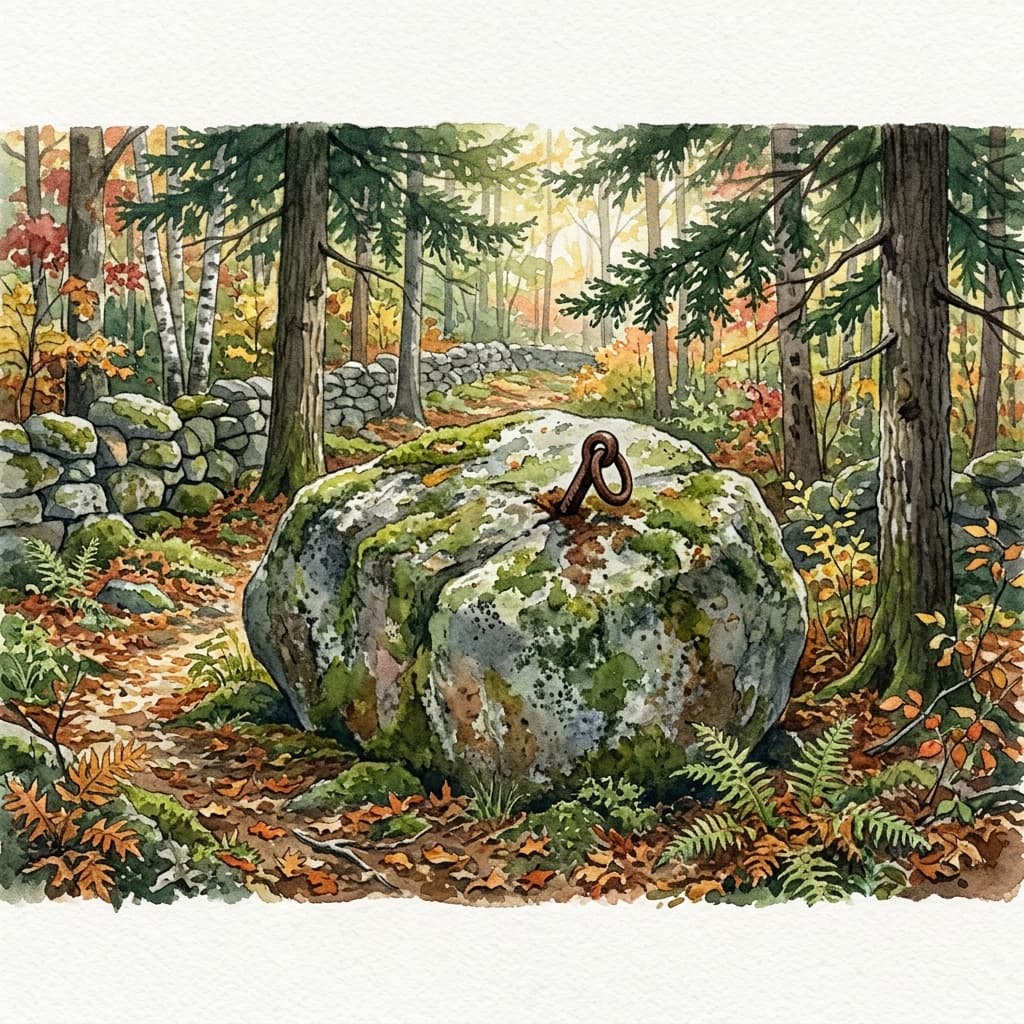
Anchor Rock Trail
Gentle stone-wall meander to the Anchor Rock — a glacial erratic locally tied to colonial-era Taft family lore — through the hemlock and hardwood of the Trustees' 186-acre Cormier Woods reservation. This segment leads to the signature boulder; the full reservation offers five miles of connected loop trails through pasture, woodland, and a boulder field.
Elevation profile
What you might spot
 Plant
PlantPink Lady's Slipper
Cypripedium acaule
Solitary pink “moccasin” flower on a leafless stalk; two broad basal leaves often visible. Massachusetts native orchid — illegal to pick or dig; photograph only.
Late May through mid-June (peak around Mendon Memorial Day week)
📍 Mendon Town Forest — acidic pine–oak understory along the Wigwam Hill loop and side spurs.
 Plant
PlantMountain Laurel
Kalmia latifolia
Evergreen-looking shrubs with smooth, oval leaves in whorls; late spring clusters of pink-and-white cup flowers. Common on Worcester County uplands — blooms slightly earlier in sunnier openings.
Late May through June along Mendon ridgelines
📍 Mendon Town Forest — sunny pockets and rocky knobs on Wigwam Hill and connecting ridges.
 Fungi
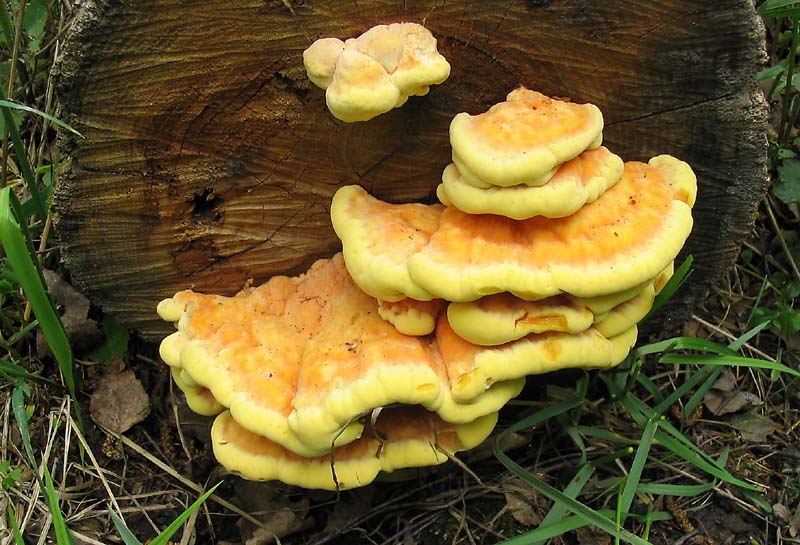
FungiChicken of the Woods
Laetiporus sulphureus
Overlapping orange shelves with sulfur-yellow pore surface underneath. Always confirm ID with a trusted guide — some look-alikes cause GI distress.
Typically August through October after humid Mendon summers
📍 Cormier Woods — mature oak and hemlock stands with abundant coarse woody debris.
 Plant
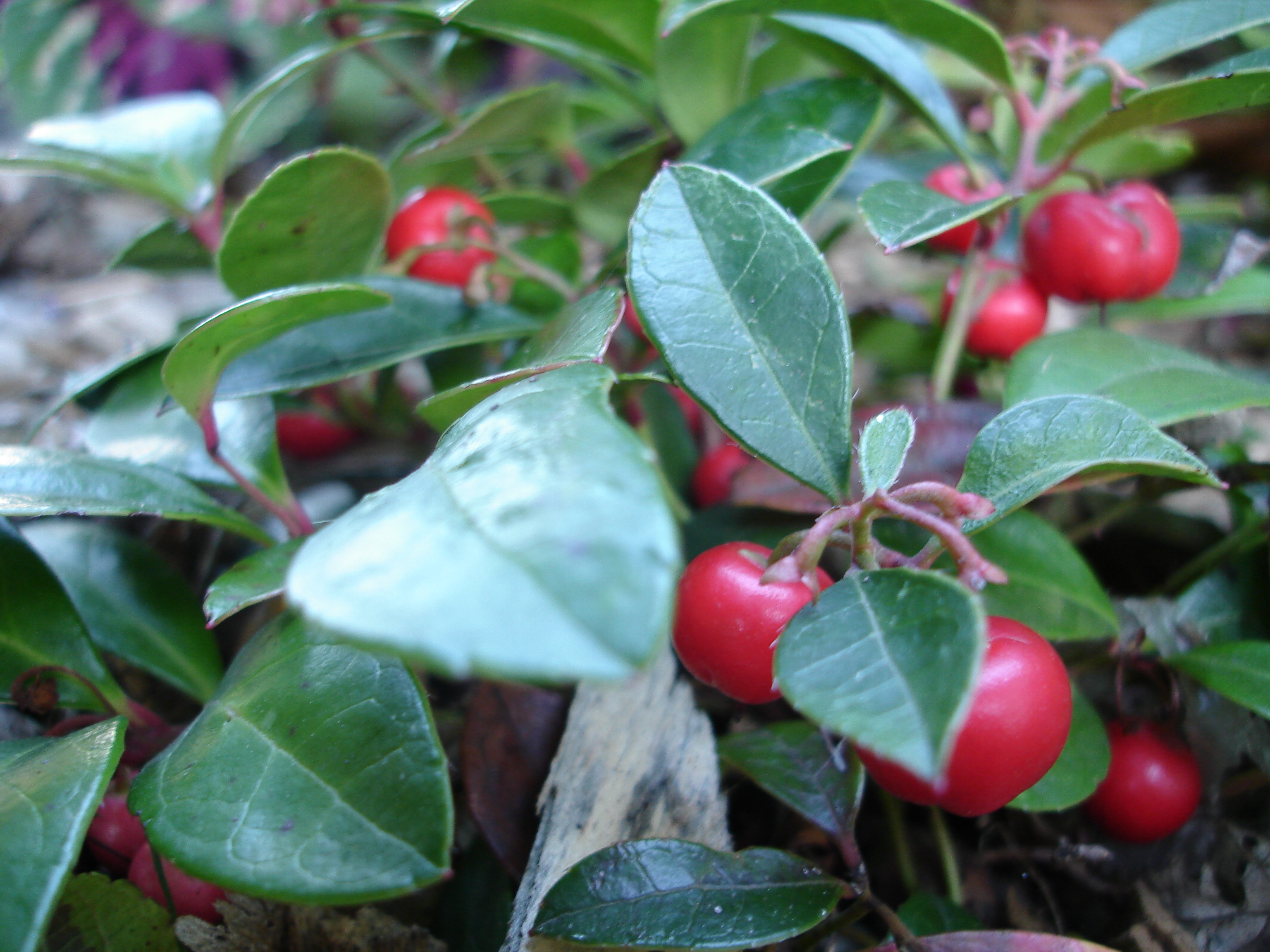
PlantWintergreen
Gaultheria procumbens
Low creeping groundcover with thick, glossy evergreen leaves and bright red berries persisting through winter. Crush a leaf for a distinctive wintergreen (methyl salicylate) scent — unmistakable. Tiny white urn-shaped flowers appear in July.
Year-round (berries most visible October through early spring under snow)
📍 Mendon Town Forest — among the most reliable groundcover species on the Wigwam Hill and Anchor Rock trails; look between pine roots and along sandy ridgetop sections.
 Plant
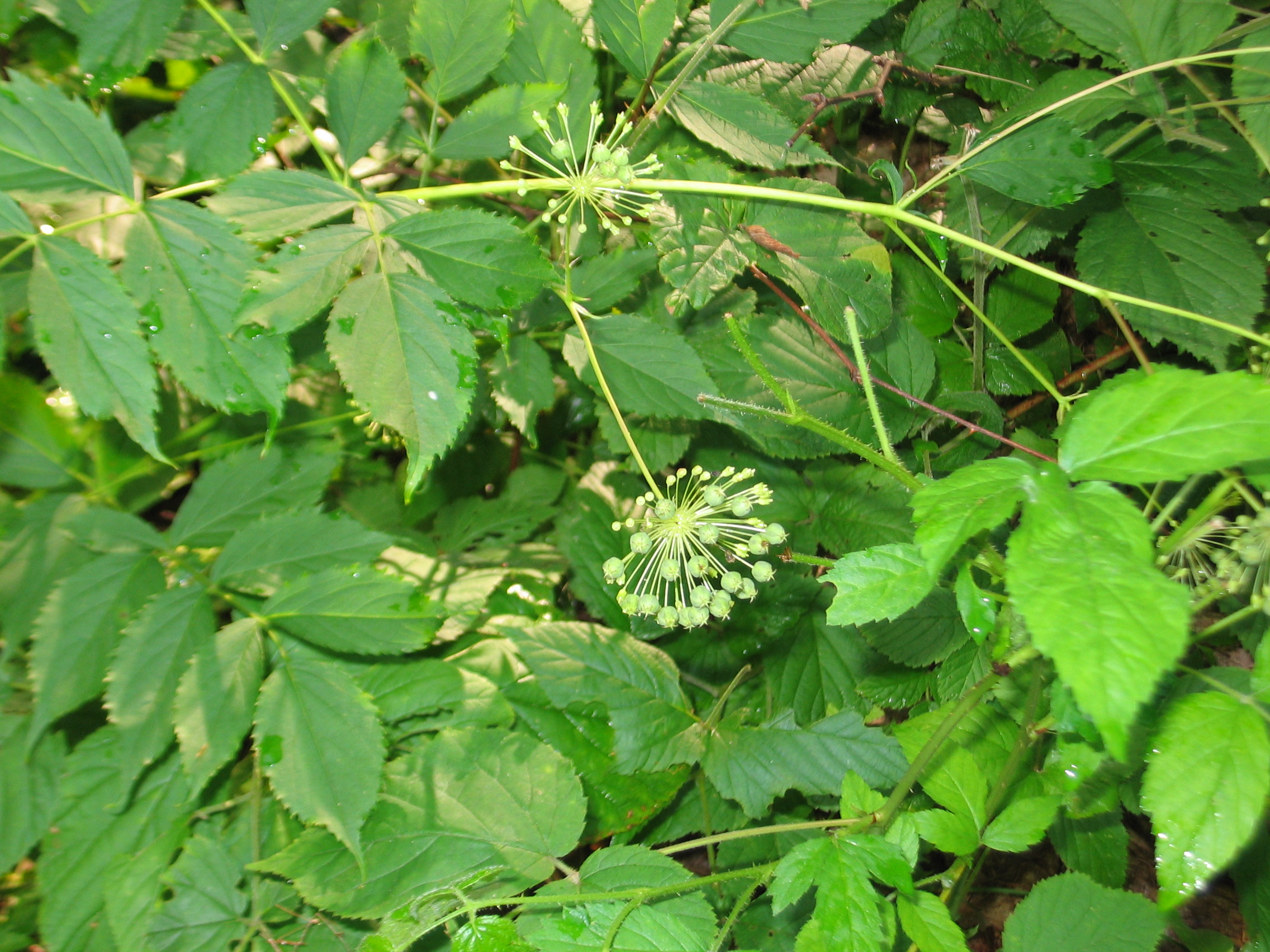
PlantWild Sarsaparilla
Aralia nudicaulis
Single compound leaf on a long stalk, divided into three groups of five leaflets — easy to mistake for a small tree seedling. A separate leafless stalk bears spherical clusters of tiny white flowers in June, followed by dark purple berries. Roots historically used as a sassafras substitute.
Leaves emerge May; flowers June; berries ripen August
📍 Mendon Town Forest — one of the most common herbaceous plants along the Anchor Rock Trail; look for the distinctive single-leaf-with-separate-flower-stalk combination.
 Wildlife
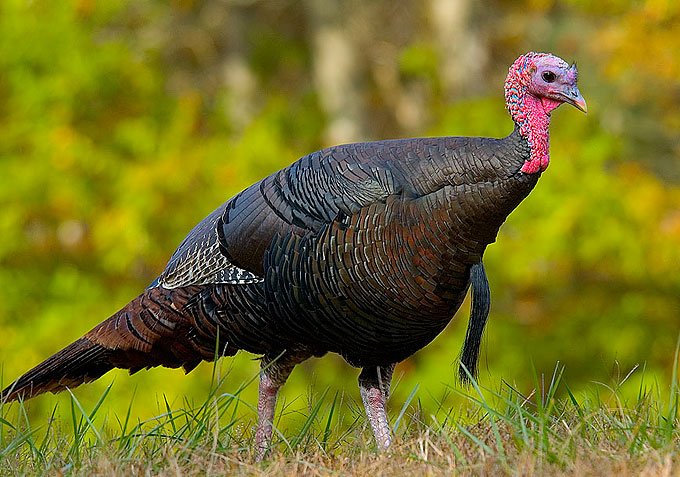
Wild Turkey
Meleagris gallopavo
Large, dark, iridescent bird with a bare red-and-blue head; males display fan-shaped tails and prominent beards. Flocks scratch loudly in leaf litter. Often heard before seen; males gobble from roost trees at dawn in spring.
Year-round; gobbling and strutting displays March–May; poults visible June–July
📍 Mendon Town Forest — flocks forage in the oak understory along the Wigwam Hill trails year-round; the dawn gobbling carries clearly from ridgetop roosts.
 Wildlife
Ovenbird
Seiurus aurocapilla
Warbler-sized but walks on the ground like a thrush; olive-brown back, streaked breast, and orange crown stripe bordered by black. The call — a ringing, escalating “teacher-teacher-TEACHER” — carries through the forest all summer and is far more often heard than the bird is seen.
Arrives early May; sings through July; departs by September
📍 Mendon Town Forest — one of the most abundant breeding birds in the interior oak forest along Wigwam Hill; the loud, repetitive call is nearly constant on summer mornings.
 Fungi
FungiTurkey Tail
Trametes versicolor
Thin, leathery, multi-colored concentric zones — tan, brown, rust, gray — fan out like a turkey's tail. The pore surface underneath is white or cream with tiny pores (not gills) — the critical check against look-alikes. One of the most common bracket fungi in New England and a good entry point for beginning foragers.
Year-round on downed wood; fruiting bodies persist through winter
📍 Cormier Woods — abundant on downed hardwood throughout the trail system; nearly every large decaying log has at least one colony.
 Fungi
FungiHen of the Woods (Maitake)
Grifola frondosa
Large, overlapping rosette of gray-brown, fan-shaped fronds arising from a single base; white pore surface underneath. Can reach 30+ lbs. Grows reliably at the same oak's base year after year. Among the most sought-after edible fungi in Massachusetts — always confirm ID before consuming.
Late September through October; earlier fruiting in wet years
📍 Mendon Town Forest — mature oaks along the Wigwam Hill and Anchor Rock trail systems; look at the base of large-diameter oaks in late September.
History in this area
Boston Post Road Milestone (1772)
1772A surviving milestone marked "37 miles from Boston," now preserved in Founders' Park as a reminder of Mendon's colonial road network.
Mendon Resolves and Lydia Chapin Taft
1773Mendon's 1773 resolves articulated natural rights language echoed in 1776, and local-born Lydia Chapin Taft is recognized as America's first woman legal voter.
LAND, CPA, and the trail network you walk
How state and local programs helped stitch together the interconnected preserves the Town lists today.
Permitted uses
Trustees of Reservations property. Mountain biking permitted except where posted. Hunting in season per state and town laws; no hunting Sundays; blaze orange recommended. Dogs must be leashed per Uxbridge town bylaws (even though Trustees generally allows voice control — local bylaw applies here). No motorized vehicles. Stay on marked trails; some adjacent land is private.
Surfaces
Accessibility
Max grade
8%
Firm surface
45%
Short and quiet, but uneven tread and roots are common after rain.
History
Cormier Woods is held by The Trustees of Reservations, one of the world's oldest land-conservation organizations, on Mendon's east side along the Upton town line. The 186-acre reservation protects a mix of hemlock ravines, mature oak-hickory forest, and a classic New England stone-wall network that traces the original colonial lot boundaries.
The Anchor Rock is the trail's signature feature: a large glacial erratic — a boulder carried and deposited by the Laurentide Ice Sheet roughly 15,000 years ago — with a rusted iron eyebolt driven into its top face. The bolt is the source of the "Anchor" name, though its exact purpose is debated. Local historians associate it with the 18th-century Taft family farmstead that once occupied this section of eastern Mendon. Robert Taft Sr. settled the area in the late 17th century; his descendants farmed the surrounding land for several generations, leaving behind the rock walls you walk beside today.
The 1800s farmstead ruins — a collapsed cellar hole and scatter of dressed granite foundation blocks — sit roughly 200 yards southwest of the Anchor Rock along a secondary path. A cluster of lilac bushes still blooms near the site each spring, a living marker of the homestead's former dooryard garden. The Trustees acquired the core parcel in the early 2000s with support from the Mendon Community Preservation Act; additional acreage was added via private donation in 2012.
Trailheads & parking
Chapin St Parking (Trustees)
Parking available
217 Chapin St, Uxbridge — Dolbear Trail loop from the barn kiosk (Trustees).